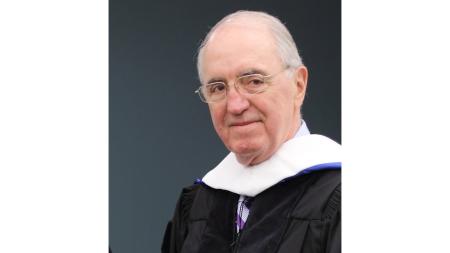
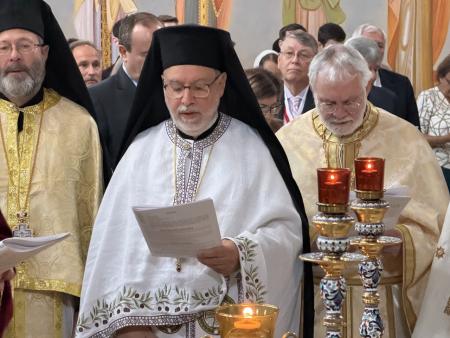
With faith in Christ and hope in the resurrection, we share news of the repose of St. Vladimir’s Seminary Trustee Emeritus Mitchell Zunich. Zunich, 93, died on the Feast of Holy Pascha, Sunday, April 19, at his home at St. Mary of the Woods Assisted Living in Avon, OH.
Zunich was born May 10, 1926 in Lorain, OH. He served with the US Army during World War II in the 357th Regiment of the 90th Infantry Division. During his service, he participated in the battles of Rhineland and Central Europe and received the European-African-Middle-Eastern Theater Ribbon with two Bronze Stars, a Good Conduct Medal, a WWII Victory Medal and an Occupation Medal for Germany. His division was awarded the Bronze Star and participated in the liberation of Flossenburg Concentration Camp. Zunich attended the Ohio State University where he earned a bachelor of science in accounting. He founded Mitchell Zunich & Co. Certified Public Accountants, retiring in 2001. He was active in the community, having served as an officer, president, and board member of many organizations including the Lorain Rotary Club, Lorain Salvation Army, Lorain Metropolitan Housing Authority, the City Bank Co., Lorain Family YMCA, Clearview School Board, and St. Vladimir’s Orthodox Theological Seminary. In the 1990s, Mitchell and his wife, Violet, helped establish a scholarship for Serbian Orthodox seminarians at St. Vladimir’s so that no young Serbian Orthodox men would be turned away from becoming priests. Zunich was a member of St. George Serbian Orthodox Church in Lorain, the Serbian National Federation, the Ohio Society of CPAs, and the AICPA.
"Mitch was honored to be on the Seminary’s Board of Trustees," said fellow St. Vladimir's Trustee Emeritus Brian Gerich. "He served many years as one of the four Serbian trustees along with [Trustee Emeritus] Alex Machaskee, Leon Lysaght, and myself.
"During our 1990’s Capital Campaign, I asked Mitch to join with me in establishing endowments for scholarships for Serbian Orthodox students studying to become priests. He immediately accepted, and he and his beloved wife Violet added to their endowment regularly. Mitch was pleased to know that as students graduated they were debt free as they prepared for a lifetime of serving our Lord."
"I remember Mitch as a quiet, decisive, compassionate gentleman who was a staunch supporter of our Orthodox Christian faith and a great contributor of time, talent, and treasure to St. Vladimir's Seminary," added Alex Machaskee. "He was a founding contributor to Monastery Marcha in Richfield Ohio, a decorated veteran of World War II, and a highly esteemed civic leader."
Mitchell Zunich is survived by his sons, Mitch Zunich of Cleveland and Rob (Eva) Zunich of Avon Lake; grandchildren, Neven, Dane, Rada, and Mila Zunich; and sister, Sophie Tyrin of Chicago. Zunich was preceded in death by his wife of 58 years, Violet M. Zunich (née Kobac) on Sept 7, 2014; infant son, Nick Zunich, in 1959; parents, Nikola & Stanka Zunich (née Kunic); brothers, Demeter, George, Nick, and Mike Zunich; and sisters, Mildred Stamatis, Dorothy Kovan, Nellie Raynovich, and Mary Zunich.
Due to restrictions on social gatherings during the COVID-19 pandemic, private family funeral services will be held. Hieromonk Nektarije Tesanovic of St. George Serbian Orthodox Church will preside with burial to follow in Elmwood Cemetery in Lorain. Memorial contributions may be made to St. George Serbian Orthodox Church, 3355 Grove Ave, Lorain, OH, 44055 or St. Vladimir’s Orthodox Theological Seminary, 575 Scarsdale Rd, Yonkers, NY, 10707. Arrangements are under the direction of Gluvna-Shimo-Hromada Funeral Chapel, 3224 Broadway Ave, Lorain. Online condolences may be made at www.gluvna.net.
May the memory of Mitchell Zunich be eternal!
--
(The photo and some information in this article have been reprinted from The Morning Journal.)
5th Annual Academic Symposium Compelling Preaching Then and Now
Attend the Keynote Address in Person or Online
The Christian Church was established with a firm directive, given by the Risen Lord Jesus Christ Himself: to go forth throughout the world, preaching the Gospel and teaching His commands, making disciples of all nations (cf. Mt. 28:19–20).
Since our Lord uttered His Great Commission to His disciples, how have Christians over the centuries shaped their preaching about Christ and His Gospel? How can their example inform or guide preaching in the Orthodox Church today?
St. Vladimir’s Orthodox Theological Seminary (SVOTS) has gathered scholars to address Compelling Preaching Then & Now for its Fifth Annual Academic Symposium, to be held November 12–14, 2026. During this two-day interdisciplinary academic conference, the scholars from the Seminary and beyond will explore figures, artifacts, buildings, or works of art from their respective disciplines that exemplify a compelling witness to the Gospel and will reflect on how that can inspire and inform compelling preaching in the twenty-first century.
The Symposium will open with a keynote address on Thursday, November 12, at 7 p.m.(EST), in the Metropolitan Philip Auditorium. A reception will follow.
Dr. Margaret M. Mitchell Shailer Mathews Distinguished Service Professor of New Testament and Early Christian Literature, University of Chicago
“The Son of Thunder Takes the Stage: John Chrysostom’s First Homily on the Gospel According to John”
The keynote address is open to the public. You are warmly invited to join us whether in person or online!
The second part of the symposium (Friday and Saturday, November 13–14) will consist of scholarly presentations by:
Dr. Theodora Antonopolou (National & Kapodistrian University of Athens)
Dr. Mihai Coman (University of Bucharest)
Cristian Ioan Dumitru (Doctoral Student, University of Bucharest)
Rev. Dr. Sergius Halvorsen (St. Vladimir’s Seminary)
Dr. Nadieszda Kizenko (University at Albany, State University of New York)
Dr. Henry Maguire (Emeritus Professor, Johns Hopkins University)
Dr. Margaret Mullett (Emeritus Professor, Queen’s University Belfast)
Right Rev. Dr. Damaskinos Olkinuora (University of Eastern Finland)
Dr. Bissera Pentcheva (Stanford University)
Right Rev. Dr. Vasily Permiakov (St. Vladimir’s Seminary)
Dr. Rossitza Schroeder (St. Vladimir’s Seminary)
Dr. Niki Tsironi (The American College of Greece)
This portion of the Symposium is open by invitation only. Scholars and students interested in attending the presentations and discussion on November 13 & 14 are asked to email the organizers at symposium@svots.edu.
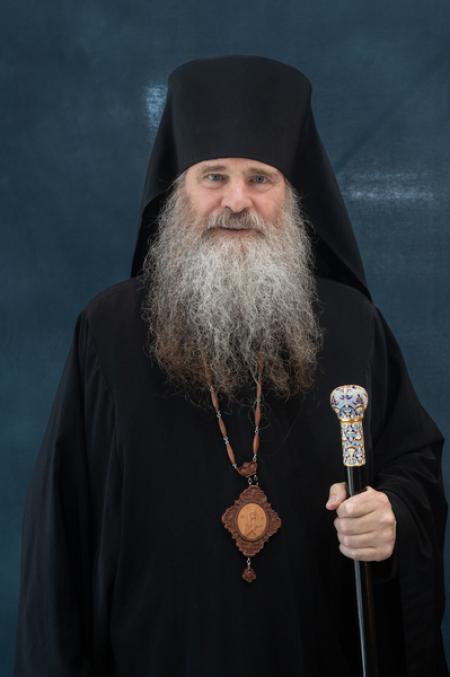
The Holy Synod of Bishops of the Orthodox Church in America met on the campus of St. Vladimir’s Seminary on Monday, November 2, and canonically elected Seminary alumnus His Grace Bishop Gerasim (Eliel) as Bishop of Dallas and the South.
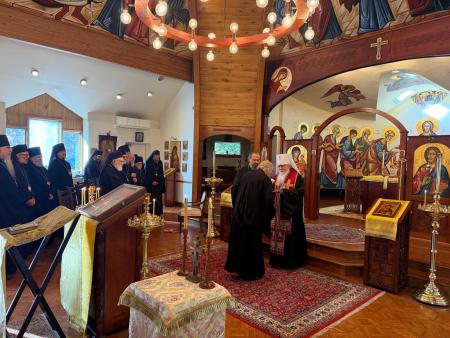
The members of the Holy Synod gathered Monday morning at the Seminary’s Three Hierarch’s Chapel for a Moleben to open their regular fall session, under the presidency of His Beatitude Metropolitan Tikhon.
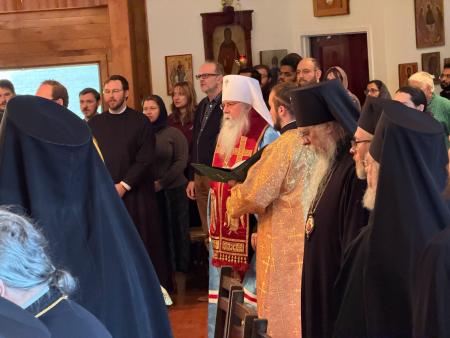
His Grace Bishop Gerasim’s election during the session marks the first time a bishop has been canonically elected on the grounds of St. Vladimir’s Seminary. In a letter informing the clergy of the Diocese of the South of the election, Metropolitan Tikhon directed that Bishop Gerasim be commemorated immediately as Bishop of Dallas and the South at all divine services, following the commemoration of the Primate of the Orthodox Church in America.
The enthronement of Bishop Gerasim will take place on Saturday, November 14, 2026, at St. Seraphim Cathedral in Dallas, TX.
His Grace Bishop Gerasim’s election follows his nomination by the clergy and lay delegates at the Special Nominating Assembly held on July 24, 2026, at St. Justin Martyr Church in Jacksonville, FL. His Grace has served as Locum Tenens of the Diocese of the South since July, following the retirement of His Eminence Archbishop Alexander. Consecrated to the episcopacy on June 29, 2021, Bishop Gerasim previously served as Bishop of Fort Worth and Auxiliary to the Diocese of the South.
His Grace Bishop Gerasim graduated from St. Vladimir’s Seminary with a Master of Divinity (M.Div.) degree in 2012. He was the class valedictorian and also received commendations for contribution to community life and for his thesis, “Russian Icons in a Native Church: Conflict in Culture in Western Alaska.”
With faith in Christ and hope in the Resurrection, we share news of the repose of Brian (Obren) Gerich, Hon. D.H.L., of Moorpark, CA, Trustee Emeritus and former Board Chair of St. Vladimir’s Seminary. Gerich fell asleep in the Lord in the early morning hours of October 29.
Brian Gerich was born in 1938 in Ventura, CA, to devout Serbian Orthodox parents, and the faith he received at home shaped everything he went on to do. For more than six decades he was a faithful member of St. Steven's Serbian Orthodox Cathedral in Alhambra, CA, where he served as trustee and treasurer for many years and which was pastored by St. Vladimir’s Seminary alumni Fr. Nicholas Ceko, Fr. Blasko Paraklis, and Fr. Norman Kosanovich.
Gerich loved St. Vladimir's Seminary. An exceptionally faithful steward, his generosity toward the institution began in July 1983 and continued until the end of his life. Over more than two decades on the Board, he served on the Finance, Audit, Advancement, and Executive Committees, and co-chaired the Seminary’s first major capital campaign, which brought a great expansion of the Seminary’s facilities and programs. His generosity to the annual budget, to capital projects, and to the Seminary endowment was unparalleled.
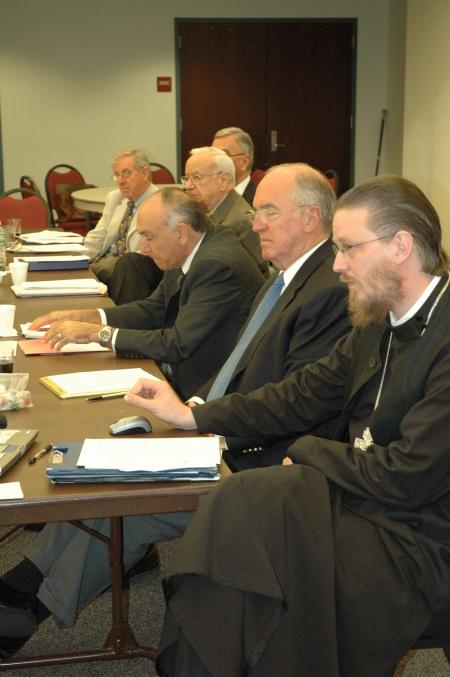
Brian Gerich (second from right) at a Board of Trustee Meeting at the Seminary in 2007.
Gerich’s heart was especially with the seminarians. Together with his beloved wife Marilyn, he established four scholarship funds: The Petar L. and Olga Gerich Family Scholarship Fund (1993), The Brian and Marilyn Gerich Scholarship Fund (1997), The Professor Veselin Kesich Scholarship Fund (2001), and The Dr Albert Rossi Endowed Scholarship Fund for Clinical Pastoral Education (2013). He also paid the necessary fees so that seminarians could complete their Clinical Pastoral Education (CPE). He often spoke of how St. Vladimir’s graduates had blessed his own parish, and he worked to see that blessing multiplied in parishes across North America.
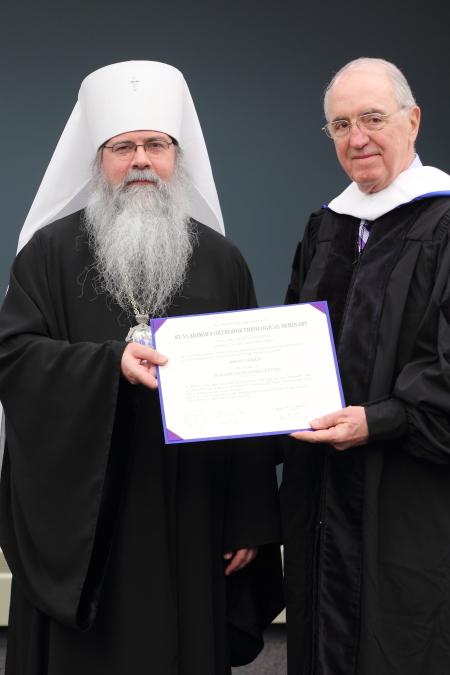
In 2013, His Beatitude Metropolitan Tikhon presented Gerich with the degree of Doctor of Humane Letters, honoris causa. The citation opened with the words of our Lord: “For where your treasure is, there your heart will be also” (Luke 12:34). No verse could describe him better. (The full text of the citation is provided below).
Beyond the Seminary, Gerich served the wider Church on the boards of FOCUS North America and IOCC, and was chairman of the Serbian Orthodox National Stewardship Committee. He was honored with the Order of St. Sava, the Order of St. Innocent, and the Ellis Island Medal of Honor.
Gerich is survived by his wife Marilyn and their daughters Carrie Bullard and Julia Brankovic; sons-in-law Brian Bullard and Alex Brankovic; many grandchildren; and come March of 2027 the special addition of a great-grandson.
May the memory of Brian Gerich be eternal!
HONORARY DEGREE CITATION (Bestowed in May of 2013)
“For where your treasure is, there your heart will be also” (Luke 12:34). These words manifestly describe your actions and what lies at the center of your heart, Obren B. Gerich.
Using your God given talents by gentle and persuasive words and bold deeds that challenge others, you are a builder and beautifier of all that is good and in need of your sacrificial time and resources.
Freely giving your wisdom and counsel, you lead through genuine example and faith.
A discerning judge of what is practical and sound, you are not dissuaded to implement what to others are only dreams.
With a life characterized by personal and professional achievements and honesty, rooted in the love of family and fed by faith, you freely give of earthly treasure while your heart burns for the love for Christ.
Truly we may say that you are a philanthropist—a Christ-centered friend and honorable human being.
Therefore it is with great honor that the Board of Trustees of St. Vladimir’s Orthodox Theological Seminary, by unanimous decision and by the power vested in them by the Board of Regents of the State of New York, bestows upon Mr. Obren B. Gerich the degree of Doctor of Humane Letters (D.H.L.) honoris causa.
With faith in Christ and hope in the Resurrection, we share news of the repose of Dr. Constantine H. Kallaur, an alumnus and great supporter of St. Vladimir’s Seminary and an important figure in the history of the Orthodox Church in America (OCA). He was Professor Emeritus of SUNY-Nassau Community College, Garden City, NY, and a member of the OCA’s Department of External Affairs and Interchurch Relations for many years; he was, notably, the last living participant of the group that represented the OCA in Moscow for the reception of the Tomos of Autocephaly in 1970. Dr. Kallaur fell asleep in the Lord on the feast of the newly canonized St. Olga, October 27, 2026 surrounded by family.
Constantine Kallaur was born in Horodno, Poland (now Belarus) on February 3, 1934, the third of four children born to Archpriest Ippolit Kallaur and Matushka Marie. He came to the US in 1950 because of World War II.
After graduating from Crosby High School in Waterbury, CT in 1953, he enrolled in a joint program between St. Vladimir’s Orthodox Theological Seminary and Columbia University, graduating with a B.S. from Columbia University in 1958 and an ABD from St. Vladimir’s. His seminary studies served as a launching pad for his later work for the Church.
“Of my many treasured memories from student days at St. Vladimir’s,” he once noted, “one comes to mind: our kitchen, kolkhoz. Four of us students banded together to feed ourselves, as there was no cafeteria at that time: Fr. Alvian Smirensky, a fantastic cook who managed to create something tasty out of practically nothing; Fr. Dmitry Grigorieff, a connoisseur of wines who could find a good bottle for one dollar; and Fr. Daniel Hubiak and I, who did the dishes!”
After his seminary studies, Dr. Kallaur went to the Ecumenical Institute at Bossey and then continued further theological studies at the University of Basel, both in Switzerland. Upon his return, Fr. Schmemann, Dean of St. Vladimir’s seminary at that time, secured funds for him to do a survey of Orthodox Christian college students on U.S. campuses; the work was done under the auspices of the National Student Christian Federation. Dr. Kallaur completed the survey and submitted it to the Standing Conference of Orthodox Bishops in America (SCOBA). On the basis of his survey, SCOBA established a permanent office of Orthodox Christian Fellowships, with James Couchell (who became Bishop Dimitri+) as its first director.
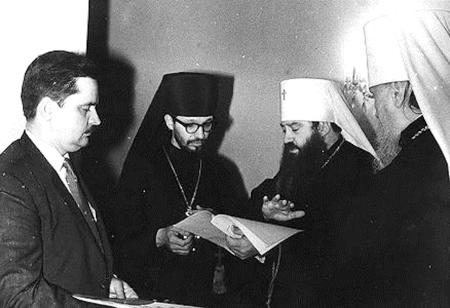
Dr. Kallaur went on to get his master’s and doctoral degrees in Russian Language and Literature. He taught for more than forty years on the college level for the State University of New York, Nassau Community College, on Long Island. Within the OCA, Dr. Kallaur served in what was then called the Department of External Church Affairs for approximately forty years. During that same time he also was one of the OCA representatives to the National Council of Churches of Christ, USA (NCCC). Additionally, he often served as an interpreter for NCCC delegations going to and coming from Russia. He had the further privilege of being one of two laymen in the delegation of seven that travelled to Russia in May 1970 to receive the Tomos of Autocephaly for the OCA. As a devoted member of the Orthodox Church in America, Dr. Kallaur contributed his talents in many areas. Always willing to offer assistance when asked, he was involved on many other Church committees and commissions.
At the conclusion of Dr. Kallaur’s studies in Switzerland, he stopped in Paris to spend the summer at the St. Sergius Orthodox Institute to do research. Here he met his future wife, Arlene, who was studying at the Sorbonne. They were married on September 8, 1963. Arlene also served the OCA in various capacities, including as a member of the Department of Religious Education for many years and the Department of Lay Ministries. Dr. Constantine and Arlene were longtime members of Holy Trinity Church, East Meadow, New York. Living on Long Island near the Church’s administrative headquarters in Syosset, NY, they provided material support and welcoming graciousness to local and visiting hierarchs, clergy, and dignitaries. Their warm engagement with other people resulted in many relationships and friendships throughout the world, a mark of true Orthodox Christian hospitality. At the same time, they had a sincere but unassuming concern for the needy, offering moral and material support to the less fortunate, even strangers. The Kallaurs had three sons, one of whom also attended St. Vladimir’s Seminary and is a priest, Fr. Michael H. Kallaur (Class of ’94).
Dr. Constantine and Arlene Kallaur’s support and generosity extended to St. Vladimir’s Seminary throughout their lives, where they established The Very Rev. Ippolit and Matushka Marie Kallaur Scholarship Fund.
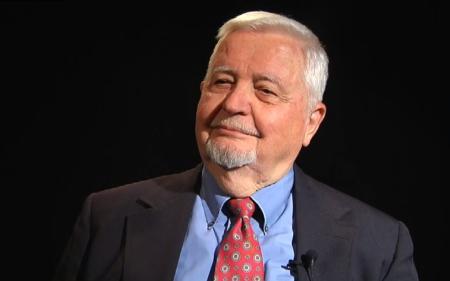
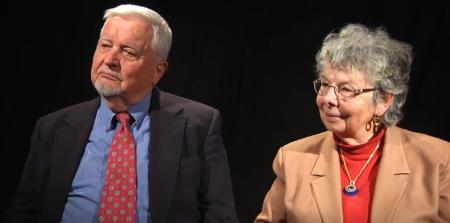
Dr. Constantine and Arlene were featured in a series of interviews conducted in 2017 by Fr. John Shimchick and Diana Pasca. The interviews may be viewed here.
Prof. Kallaur is survived by his wife Arlene and their three sons: Gregory Kallaur and his wife Kelly, of Baltimore, MD; Fr. Michael Kallaur and his wife Eleni, of Pittsburgh, PA; Daniel Kallaur and his wife Ly, of Charlotte, NC; nine grandchildren: Alexandra, Julia, and John; Constantine, Apostoli, and Luke; Alexia, Danielle, and Hunter James; Dr. Kallaur’s sister Alla Lewykin (+Ivan); and brother, Walter V. Kallaur (+Carolita). Dr. Kallaur’s older sister Vera Lundberg (+Gustav) fell asleep in the Lord in 2022. Dr. Kallaur is also survived by his brother-in-law Michael Pilat and his wife Lois, of Berea, OH.
In lieu of flowers, donations may be sent to the Orthodox Church in America.
The schedule of services for Dr. Constantine is as follows:
Monday, November 2 6 p.m. Panikhida at Nativity of the Holy Virgin Orthodox Church, Charlotte, NC
Friday, November 6 7 p.m. Funeral Service at St. Tikhon’s Monastery Church, South Canaan, PA
Saturday, November 7 10:30 a.m. Panikhida followed by burial at St. Tikhon’s Cemetery
May Dr. Constantine’s Kallaur’s memory be eternal!
Some of the text used for this article has been adapted from OCA.org.
“The more believing you get, the more daring you become.”
The Preacher’s Workshop is a semimonthly blog showcasing homilies that exemplify excellence in rhetoric, exegesis, narrative, and imagery. This new resource for preachers is part of St. Vladimir’s Seminary's Compelling Preaching Initiative, which is generously sponsored by the Lilly Foundation.
Our second featured homily is “Fear and Trembling,” delivered in 1994 by Protopresbyter Thomas Hopko (March 28, 1939–March 18, 2015). This homily was recently published by Ancient Faith Radio (AFR) as part of a collection titledFr. Thomas Hopko: The Cassette Lectures. Read this beautiful homily in its entirety, along with a summary of what makes it so compelling.
Invitation to Encounter God - The homily opens by talking about when people encounter God. Choosing “when” over “if” serves as a profound confession that these encounters are real and challenges listeners to seek out their own encounters with the divine.
Redefining Fear - The homily presents a compelling idea of fear of God as a lifegiving posture of faith that overcomes all other kinds of fear, even the fear of death. Unlike an either/or argument in which the hearer considers two equally plausible options, an argument based on redefinition presents the good option—godly fear—as being vastly superior to other kinds of destructive fear. This tends to lead the hearers to desire godly fear as the lifegiving and empowering option; to say to themselves, “I want to have the courage that comes from godly fear.”
Biblical Imagery: While the central biblical imagery is drawn from the lectionary text for the day with the hemorrhaging woman and Jairus and his sick daughter, the homily includes other biblical examples of fear and trembling: the Nativity narrative where Mary, Joseph, and the shepherds all encounter the divine with fear and trembling and are told by the angels the leitmotif, “Do not be afraid”; and a passing reference to the Centurion who asks Jesus to heal his servant.
A Call to Action: The concluding images of boldness call the hearers to faithful, boldness before God. This is particularly evident in the statement, “The more believing you get, the more daring you become,” and especially in the last line of the homily which asks God to grant us the right kind of fear and the right kind of boldness so that God’s power can work in and through us.
“Fear and Trembling”
by Fr. Thomas Hopko
When human beings, who are real human beings, know who they are before the face of God—knowing that they and we are creatures, and that we are sinners—when such a human being comes into touch with the real God, and when the real God encounters a human being, and the God is the real God, not some idol or someone that we have produced in our own minds; when you have the encounter between God as God really is, and human beings who really know their humanity and their creaturehood, then there are several things that always result.
And everywhere through the Bible and the history of the Church and the Scriptures and the saints, we always see this: What you see happening is that the creature who really comes into touch with the real God always has the reaction of fear and trembling, of a sense of awe, a sense of wonder, a sense of the fear of God, godly fear. This always happens, that when there is a real encounter with God then the person has a sense of awe and fear and even terror.
We see this in the Gospel today when the woman with the flow of blood discovers that she has been uncovered in her touching of God, and it says that she was with fear and trembling before him. That fear and trembling is always there when it’s the presence of the real God.
Those who would think of God simply as some kind of smiling face on a bumper sticker,“God is love,” “God is the friend in the sky,” “God is just the one available that I’m supposed to order around with my prayers and tell him what to do,” and so on, then that’s not yet an encounter with God. When there is an encounter with God, it’s always as they say in textbooks mystérium treméndum, mystérium treméndum et fascinans. It’s awesome, it’s inspiring, and it is creating in the sense of the creature, a sense of creaturehood, then the sense of sinfulness.
But when that encounter is real, and when the godly fear is the right kind of godly fear, because there's also a wrong kind of godly fear. There’s a wrong fear where people only are in terror before God. They think of God as some kind of cosmic cop out to catch us, to watch us, to see what we do.Can’t wait to see that we are doing something wrong so that we can be punished or thrown into hell or something. There are people who have that view of God, too, and that's not the real God either.
But when the godly fear is the right kind of godly fear, and awe in the presence of the majesty, the glory, the splendor, the power, the total holiness of God, in fact, even in the presence of the love of God, the kindness of God, the compassion of God, then there really is this sense of awe, but there is also at the same time a sense of attraction. A sense of being drawn. A sense of saying, “Lord, it is good to be here,” like the apostles on the Transfiguration who couldn’t look at the face of the shining Christ, but at the same time said, “Lord, it is good for us to be here. Let's stay here.” And so, with the godly fear, when it’s the right kind of fear, there's also an attraction, a drawing, a beauty, a sense of goodness. In fact, it is that goodness itself that is part of the awesomeness.
St. Teresa of Ávila, a great Christian mystic, said, “When I think of the judgment of God and the justice of God,” she says, “I tremble with fear." But then she went on and said, “But when I think of God’s mercy and His love and His compassion and His kindness,” then she says, “I really tremble.” Then I really have fear because the love of God goes together with His attraction. That quality is a word, there’s a word for it in Greek, there always is. It’s the word parrhesia. And that word is usually translated in English as boldness, a kind of courage, sometimes translated as confidence in the presence of God. It’s that word for example that is used in the Liturgy before we say the Lord’s Prayer, the priest says, “And make us worthy, O Master, make us worthy, Lord, that with with boldness and without condemnation we may dare to call upon Thee as our Heavenly God, as Father, and say, Our Father…” So we say “with boldness,” and another translation may be daring.
You have just the opposite of human fear. You see, when you have godly fear, then human fear disappears. When you have godly fear, then you are not afraid of anyone or anything, except God. You know who[m] to fear. And when you know who[m] to fear, then you know who[m] not to fear. You know who[m] not to be afraid of. And so those who really know God and have this godly fear, they are not afraid of anything. They are certainly not afraid of people. They’re not afraid of devils and they are not even afraid of death. They’re not afraid of anything because they know that when God is there, there is literally nothing to be afraid of.
And how many times in the Gospels do you hear this expression, “Don’t be afraid?” “Fear not.…” You have the expression “Fear not,” “Don’t be afraid,” or some such thing, sixteen times. You have it when the angels come to the shepherds, and then Mary from the angel, and then Joseph, and then all these people coming. And we had it in this morning’s Gospel: “Fear not. Only believe, and I will be with you, and I will be there.”
And so, in the Gospel today, that woman with the hemorrhage, she was in fear and trembling. She didn’t know what to do about her illness. And on one level, she was really afraid of Jesus. She was afraid of His power, His awesomeness, His glory. She certainly was afraid to go near Him, not only because she was a woman, but because she was hemorrhaging. And if she was a hemorrhaging woman, she shouldn’t have been out on the street in the first place, according to the law, and she certainly shouldn’t go around touching people, and she certainly shouldn’t go around touching the Messiah.
But at the same time with that fear and trembling that she had, she had boldness. She dared to get out there. And she dared to get into that crowd, and she even dared to go up and touch Him.
And then, when she was found out, it says, you know, that she came shaking in front of Him. And then He came to her, and said to the woman, “Great is your faith. Great is your boldness. Great is your daring,” because it’s the right kind. And then she was healed from that very moment.
And then the same thing with Jairus and the dying child. When they said that the child was already dead, then Jesus said, “Fear not. Only believe.”
And of course, we have that, you know, “I am not worthy. I cannot have You come, I cannot have You come in under my roof.” Nevertheless, the very attraction of God produces this boldness. And a person who is really a believer is a very bold person. And the humbler you get, St. John Climacus says, “the bolder you are.” The more believing you get, the more daring you become.
And that kind of boldness is not arrogance. It’s certainly not presumption. Fr. Sophrony, who was a famous elder who died a couple years ago, who made St. Silouan so famous, he has a prayer to be said each morning, and in the prayer it says to God, “Remove from me the presumption of Thy grace, but grant to me the right boldness before Thee.”
It was said of St. Basil the Great, a very great theologian, “[He] was more tender and gentle than any woman, and yet he said he walked with such a boldness that you would swear that he owned the world.”
And as a matter of fact, those who believe in God not only own the whole world, they own the whole universe. The 100,000 million galaxies with 100,000 million stars, they’re all ours, because God says to us, “Everything I have is yours.” It’s ours. And this is the boldness that we have.
So, the more we trust God, the more godly fear we have, the more we know that we are unworthy, the greater our boldness. And there’s even the prayer before Holy Communion that says exactly that. It begins, “Lord, I am not worthy that You should enter into my house. Nevertheless, I come.” And then it says, “And grant me the boldness to approach.” The boldness, the daring, to approach and to know that You are the one who is doing this work, not me.
So, the more we know our weakness, the more we know our powerlessness, the more we know our helplessness, the more we know our creaturehood, the more we know our sinful character, the greater our boldness. The greater our boldness in the right way, because we know that without that boldness before God, we are lost. We’ve got to approach Him. We have to come to Him. He is inviting us. It’s an awesome and fearful thing.
There should be fear and trembling.
If there’s no fear and trembling, then it’s not God. But if it’s only fear and trembling, and not this parrhesia, this boldness, then it’s the wrong kind of fear and trembling. So, just as there’s the right kind of godly anger and the wrong kind of anger, the right kind of grief and the wrong kind of grief, so there’s the right kind of fear and the wrong kind of fear. There’s the right kind of boldness and the wrong kind of boldness.
So, let’s pray to God that He would give us the right kind of fear, which produces at the same time the right kind of boldness. Then we’re not afraid of anything, because it’s the power of God and not our own power that’s acting in us—the power that stopped that hemorrhage, and the power that raised Jairus’ daughter, and the power that raises all the dead, and gives God’s life, God’s majesty.
A link to the audio recording on Ancient Faith Radio can be found here.
Sacred Chant, Liturgical Function, and Orthodox Theology
Attend the Keynote Address & Evening Program in Person or Online
What does sacred chant do from the perspective of liturgy? Though their worship traditions differ profoundly, the Eastern and Oriental Orthodox Churches share a distinct ethos and theological vision of liturgy, in which music does far more than adorn prayer.
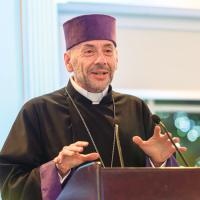
In his keynote address, “With One Voice: Sacred Chant, Liturgical Function, and Orthodox Theology,” His Grace Bishop Daniel Findikyan will explore how sacred chant is integral to the liturgy’s very operation, “energizing” it and thus enabling it to build up the Church as the Body of Christ. This insight has profound implications for the Orthodox Church’s (and Churches’) central task and mission today.
The keynote will be part of St. Vladimir’s Seminary’s Colloquium on Oriental Orthodox Liturgical Music in Theological Education. Bishop Daniel will deliver the address on Thursday, October 29,at 7 p.m.(EST), in the Metropolitan Philip Auditorium. The evening program will also include a performance of Ethiopian Orthodox liturgical chants by a vocal ensemble from St. John the Baptist Ethiopian Orthodox Tewahedo Church, Boston, MA. A reception will follow.
Bishop Daniel is one of several expert liturgical music practitioners and scholars from various traditions who are gathering at St. Vladimir’s Seminary for this Colloquium on Oriental Orthodox Liturgical Music. Along with His Grace’s keynote, the Colloquium (Thursday and Friday, October 29–30) will consist of presentations and panel discussions led by:
Dr. Gabriel Aydin
Dr. Peter C. Bouteneff
Daniel Girgis
Dr. Habtemichael Kidane
Dr. Alexander Lingas
Fr. Arsenius Mikhail
Dn. Harrison Russin
Dr. Ani Shahinian
Dr. Haig Utidjian
Juliana Woodill
In addition to the keynote address and evening program October 29, members of the public are also welcome to attend any other part of the Colloquium in person. While only the keynote address will be livestreamed, recordings of all presentations and panel discussions held October 29–30 may be made available to the public at a later date.
Bishop Daniel Findikyan is the former Primate of the Eastern Diocese of the Armenian Church of America and is Professor of Liturgical Studies at St. Nersess Armenian Seminary in Armonk, New York. Prior to his election as Primate in May 2018 he served as Director of the Krikor and Clara Zohrab Information Center of the Diocese of the Armenian Church (Eastern), New York.
Bishop Daniel is a member of the brotherhood of the Holy See of Etchmiadzin. He earned his doctorate in Liturgical Studies from the Pontifical Oriental Institute in Rome, where he studied under the late Robert F. Taft. S.J. He previously earned the Master of Arts degree in Musicology from the City University of New York and the Master of Divinity degree from St. Vladimir’s Orthodox Theological Seminary and St. Nersess Armenian Seminary.
Having published numerous articles in scholarly journals and books, Bishop Daniel served as the general editor of an innovative and acclaimed Divine Liturgy “pew book,” used throughout the Eastern Diocese of the Armenian Church of America, and has served as a model for similar liturgical books in other churches and jurisdictions.
Bishop Daniel is also a founding member of the Society of Oriental Liturgy and served as its President from 2016–2018. He is a member of several other academic and ecumenical organizations.
ABOUT THE INSTITUTE OF SACRED ARTS
The Institute of Sacred Arts (ISA) at St. Vladimir’s Orthodox Theological Seminary explores the intersection of human creativity and holiness. With a theology that is holistic, and a liturgy that unites multiple artistic disciplines and all the human senses, the Orthodox Christian tradition is ripe for the exploration and celebration of the sacred arts. Since its founding in 1938, St. Vladimir’s Seminary has fostered the study of icons, music, and liturgy. The ISA serves to extend the seminary’s mission in exploring the mutual relationship between theology and the arts by: contributing to the work of people and institutions that practice and reflect on the sacred arts; engaging people and institutions of all backgrounds with Orthodox artistic tradition; inspiring wider public interest in spirituality and the arts. Learn more at www.instituteofsacredarts.com.
The centenary celebration of St. George Orthodox Christian Church in Fishers, IN, in early October was the setting of a particularly blessed occasion for members of the St. Vladimir’s Seminary community.
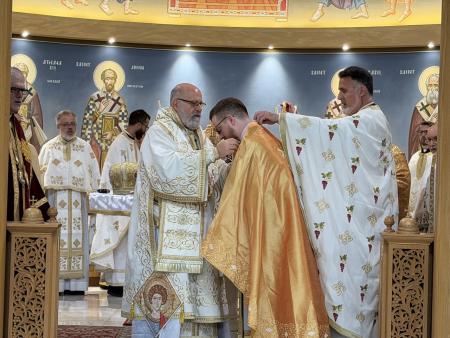
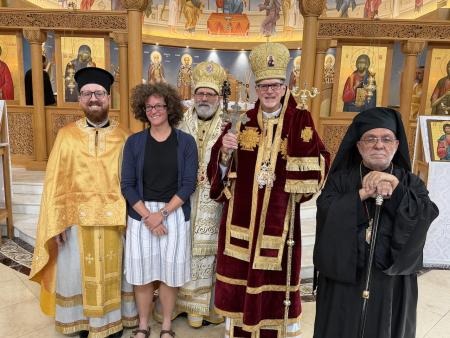
As the parish celebrated 100 years, its new Church building was consecrated on Saturday, October 10. During the Divine Liturgy His Grace Bishop John (Abdalah) ordained Seminarian Dn. Andrew Neel to the Holy Priesthood, and Seminary alumnus Fr. Anthony Yazge was elevated to the dignity of Archimandrite.
Fr. Andrew and Khouria Becca Neel with Bishop John, Bishop Anthony, and Bishop Thomas.
The Rev. Andrew Neel, who is in his third and final year of study in the Seminary’s Master of Divinity (M.Div.) program, is a son of another Indiana parish, St. Ananias the Apostle Church in Evansville.
Archimandrite Anthony Yazge
The Right Rev. Archimandrite Anthony G. Yazge graduated from St. Vladimir’s Seminary with an M.Div. degree in 1988, and is the pastor of St. George. Fr. Anthony is also Dean of the Indiana Deanery. He presently serves on the Alumni Association Board at St. Vladimir’s Seminary (he was previously Board President), and is a member of the Board of Faithtree Resources. His many years of priestly ministry include service as Camp Director of the Antiochian Village Camp, Chairman of the Department of Camping, Chairman of the Department of Young Adult Ministry, SOYO Priest in Charge of the Special Olympics Camp, and NAC Teen SOYO and Midwest Teen SOYO Spiritual Advisor.
Fr. Anthony’s late wife Dr. Stefanie Yova Yazge, who fell asleep in the Lord in 2017, was also a graduate of St. Vladimir’s Seminary (M.A., ’86) and served as Alumni Association Board Secretary. She and Fr. Anthony had three children, who are now adults: Matthew, Mark, and Alexis.
May God grant many years to Archimandrite Anthony, Priest Andrew, and their families!
Photos and some information for this article have been adapted from Antiochian.org.
Throughout its history, St. Vladimir’s Orthodox Theological Seminary has served, and continues to serve, as a training ground for Orthodox men and women, preparing them to serve the Church in its many ministries. The Church needs bishops, priests, and deacons, as well as scholars, teachers, catechists, choir directors, and educated leaders of many kinds. If you feel called to ministry in the Church, are interested in broadening your understanding and experience of the Orthodox Christian Faith, and are curious about what seminary life is like, then please join us on campus at the St. Vladimir’s Seminary Fall Open House on October 18–19, 2026.
At this Open House, prospective seminarians are invited to experience “life at St. Vladimir’s” in its many facets. Worship with the Seminary community in the chapel, attend classes, and speak with seminarians and professors about the spiritual, academic, and residential life at the Seminary. Come and see if St. Vladimir’s Seminary is the place for you!
Transportation: Open House attendees will be responsible for their transportation to and from the Seminary.
Arrival & Meals: Attendees are welcome to arrive as early as Saturday, October 17 and to stay through Tuesday, October 20. Meals during the official Open House, October 18-19, will be provided free of charge. If your stay extends beyond these dates in either direction, meals will be available for purchase.
Housing: Pending available space, attendees may request to be housed on campus on a first-come, first-served basis for free, at the invitation of St. Vladimir’s Seminary. Alternatively, rooms may be booked at the Hampton Inn & Suites Yonkers-Westchester; a block rate is available until September 17, 2025. (*Click the link below to book a room at the discounted rate, or call Hilton Reservations at 914-377-1144 [Option 1] and reference the group name, St Vladimir's Seminary, or the group code, 919.)
Open House Registration Deadline: The registration deadline is Tuesday, October 13, 2026.
2:00 p.m. — Welcome from Dean & Faculty Roundtable in the Gerich Boardroom (Rangos Building)
3:30 p.m. — Meet with Fr Michael Nasser, Director of Spiritual Formation in the Gerich Boardroom (Rangos Building)
5:00 p.m. — Daily Vespers at Three Hierarchs Chapel
5:45 p.m. — Dinner with Dean & fellow prospective students (Germack)
*This is the official end of the Open House; if you would like to stay through Tuesday, October 20, you are more than welcome—please let us know, especially if you would like to attend one of the classes, schedule a meeting with the Registrar/Associate Dean for Academic Affairs, and/or have lunch in the refectory on Tuesday.
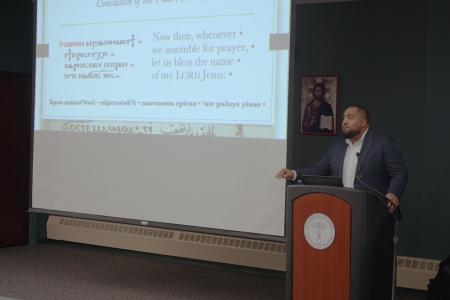
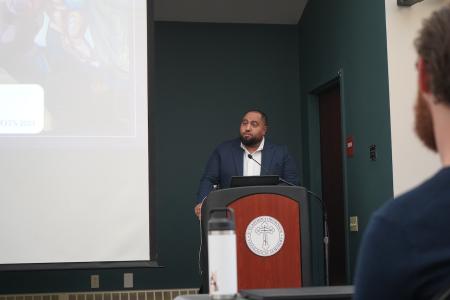
This fall the community of St. Vladimir’s Seminary continued its exploration of interactions between Eastern and Oriental Orthodox liturgical chant. On Friday, October 2, Seminary alumnus Daniel Girgis (M.A. ’21) led a workshop illustrating the depth and beauty of the Coptic liturgical music tradition.
Girgis, born and raised in New York City, is a lifelong member of the Coptic Orthodox Church. He is a subdeacon and chanter and has spent several years intensely studying Coptic liturgical music. His research focuses on the restoration and preservation of Coptic liturgical tradition through the study of Orthodox theology, the analysis of Coptic liturgical manuscripts, and the oral transmission of Coptic chant. Girgis is currently completing a liturgical study and musical translation of the Coptic Psalmody that will be published by St. Vladimir's Seminary (SVS) Press.
“Some of [these traditional hymns] are really beautiful pieces of music that are very enjoyable and very meditative,” said Girgis, as he explained and demonstrated various musical forms to members of the Seminary community in attendance.
Later this month, on October 29–30, Girgis will return to the Seminary, along with other expert liturgical music practitioners and scholars from various traditions, for the colloquium on Oriental Orthodox Liturgical Music in Theological Education. The event will be open to the public—more information is forthcoming!
ABOUT THE INSTITUTE OF SACRED ARTS
The Institute of Sacred Arts (ISA) at St. Vladimir’s Orthodox Theological Seminary explores the intersection of human creativity and holiness. With a theology that is holistic, and a liturgy that unites multiple artistic disciplines and all the human senses, the Orthodox Christian tradition is ripe for the exploration and celebration of the sacred arts. Since its founding in 1938, St. Vladimir’s Seminary has fostered the study of icons, music, and liturgy. The ISA serves to extend the seminary’s mission in exploring the mutual relationship between theology and the arts by: contributing to the work of people and institutions that practice and reflect on the sacred arts; engaging people and institutions of all backgrounds with Orthodox artistic tradition; inspiring wider public interest in spirituality and the arts. Learn more at www.instituteofsacredarts.com.
ABOUT THE CALVIN INSTITUTE OF CHRISTIAN WORSHIP
The Calvin Institute of Christian Worship (CICW), located at Calvin University and Calvin Theological Seminary in Grand Rapids, Michigan, is an interdisciplinary study and ministry center that promotes the scholarly study of the theology, history, and practice of Christian worship and the renewal of worship in worshipping communities across North America and beyond.
ABOUT THE LILLY ENDOWMENT
Lilly Endowment Inc. is an Indianapolis-based private philanthropic foundation created in 1937 by J.K. Lilly, Sr. and his sons Eli and J.K. Jr. through gifts of stock in their pharmaceutical business, Eli Lilly and Company. Although the gifts of stock remain a financial bedrock of the Endowment, it is a separate entity from the company, with a distinct governing board, staff, and location. In keeping with the founders’ wishes, the Endowment supports the causes of community development, education, and religion and maintains a special commitment to its founders’ hometown, Indianapolis, and home state, Indiana. A primary aim of its grantmaking in religion is to deepen the religious lives of Christians, principally by supporting efforts that enhance congregational vitality and strengthen the leadership of Christian communities. The Endowment values the broad diversity of Christian traditions and endeavors to support them in a wide variety of contexts. The Endowment also seeks to foster public understanding about religion by encouraging fair, accurate, and balanced portrayals of the positive and negative effects of religion on the world and lifting up the contributions that people of all faiths make to our greater civic well-being.