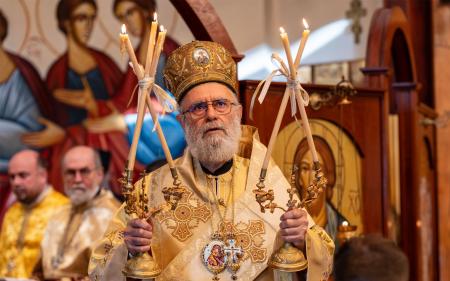
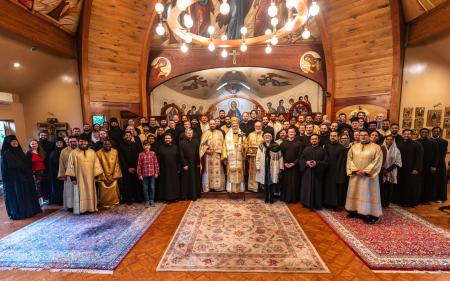
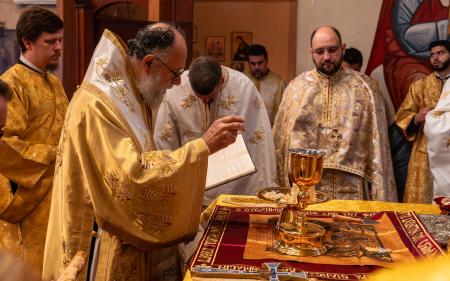
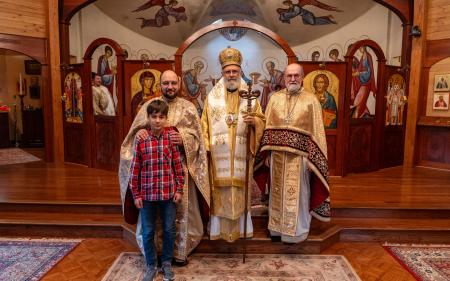
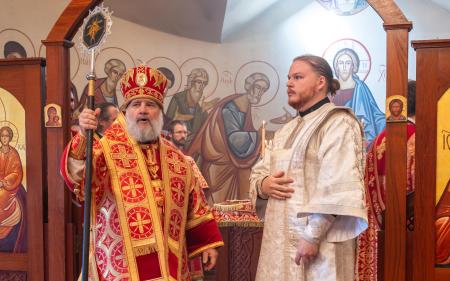
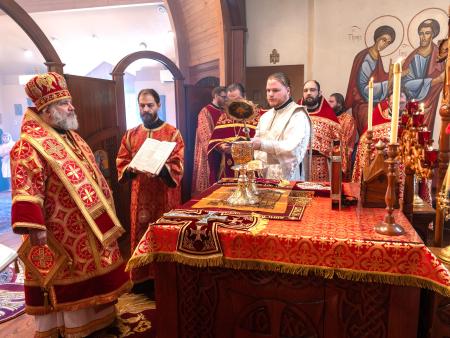
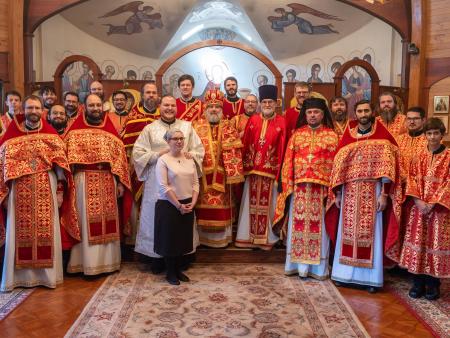
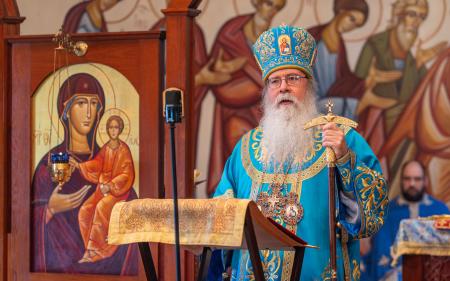
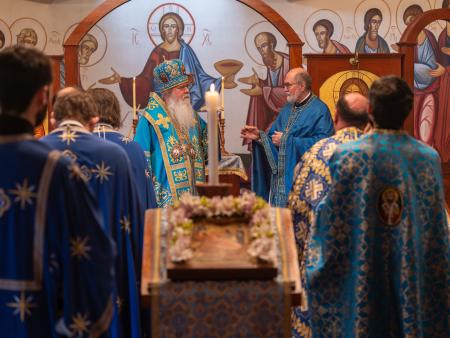
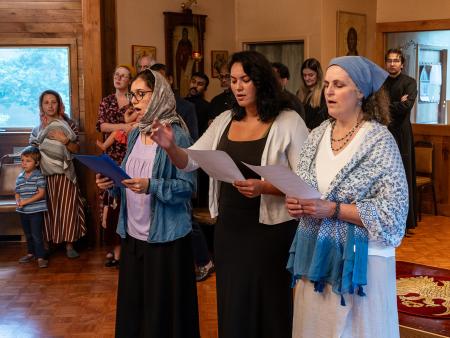
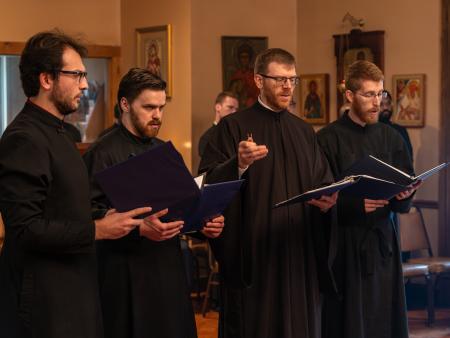
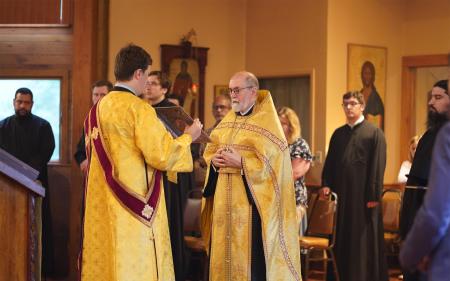
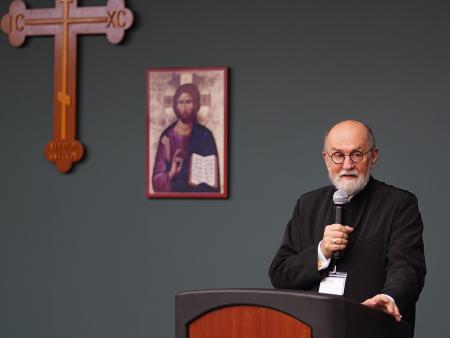
On Thursday, September 28, His Eminence Metropolitan Saba, primate of the Antiochian Orthodox Christian Archdiocese of North America (AOCANA), celebrated the Hierarchical Divine Liturgy at Three Hierarchs Chapel on the campus of St Vladimir's Orthodox Theological Seminary (SVOTS).
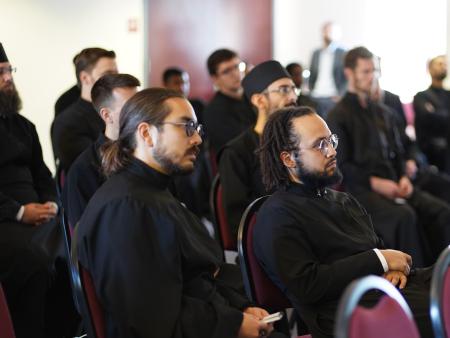
His Eminence made his first official visit to SVOTS at the invitation of His Beatitude Metropolitan Tikhon, primate of the Orthodox Church in America (OCA). Welcoming him at the seminary were SVOTS President, the Very Rev. Dr Chad Hatfield, the faculty, and the seminarians, especially the Antiochian students and recent graduates who served alongside Metropolitan Saba and sang with the Byzantine Choir. The Byzantine Choir was led by the Rev. Nicholas Fine (M.Div.’23), newly appointed Lecturer in Liturgical Music.
During the Divine Liturgy, His Eminence elevated Fr Bogdan Bucur to the dignity of archpriest. The Very Rev. Dr Bogdan Bucur is Associate Professor of Patristics at SVOTS and an archpriest of the Antiochian Archdiocese.
The day also marked the commemoration of St Isaac the Syrian. His Eminence included commemorative prayers for His Eminence Metropolitan Isaac of Germany and Central Europe, and all those who keep St Isaac as their patron. In his homily, Met. Saba highlighted the great emphasis St Isaac placed on humility in his writings, and encouraged the faithful in attendance to strive to attain humility first in their pursuit of the virtues.
Following the liturgy, His Eminence met with the Antiochian seminarians and the faculty, stressing the importance of priestly formation and ministry. Expressing gratitude for His Eminence’s visit, Fr Chad Hatfield remarked, “We look forward to building upon our 70-year-long relationship with the Antiochian Archdiocese now under the pastoral care of His Eminence, Metropolitan Saba.”
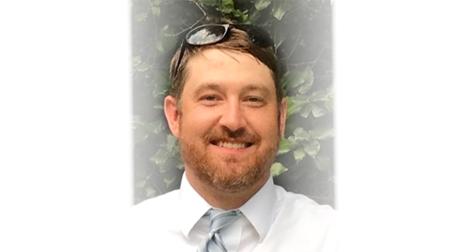
With faith in Christ and hope in the resurrection, we share the news of the repose of St Vladimir’s Seminary alumnus James Loxley Compton (M.A.’10), who fell asleep in the Lord on September 22, 2023 at the age of 40, in his home in Monroeville, AL.
James was born on May 2, 1983. He attended St Vladimir’s Seminary from 2008-2010. In May 2010, he received a Master of Arts Cum Laude and was recognized for his thesis, Oikonomiae Sacramentum: The Mystery of the Economy in Tertullian’s Against Praxeas. After his graduation from seminary, James went on to teach philosophy as a lecturer at Auburn University and attained a Ph.D. in Philosophy from the University of Birmingham in AL.
An Orthodox funeral for James Compton will be held on Tuesday, October 3, at 11 a.m. at St Dunstan’s Episcopal Church in Auburn, AL. Fr Paul Lundberg, administrator of the Greek Orthodox mission in Auburn will be officiating.
May the memory of James Loxley Compton be eternal!
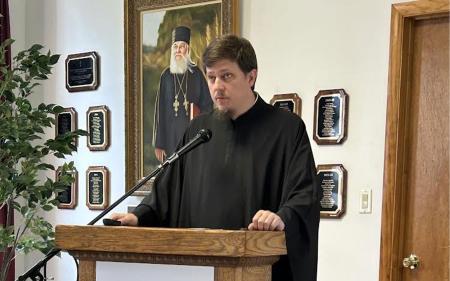
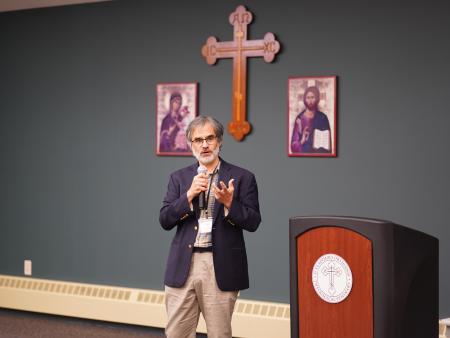
Holy Trinity Seminary in Jordanville, NY celebrated the 75th anniversary of its founding over the weekend of September 15-17, 2023. On Saturday, Sept. 16, Assistant Professor of Liturgical Theology, the Rev. Dn Dr Vitaly Permiakov presented a talk at the public program “The Orthodox Christian Seminary in the 21st Century,” hosted by Holy Trinity Seminary.
The goal for the program was to “encourage broad knowledge of everything that prepared the way for today’s Orthodox Seminary program, and how this may be interpreted for the benefit of contemporary pastoral objectives.” Dn Vitaly’s presentation, “The Orthodox Seminary Endeavor in the West,” covered a detailed history of institutional seminary education in North America, focusing especially on the formational period in the 1930s-1950s, when perceived differences in vision led to the “emergence of several theological schools serving the Orthodox people in North America–it divided the efforts but providentially served to emphasize different strengths.” Dn Vitaly stressed that “now that communion between the churches has been restored, we are called to closer cooperation in view of our common goal, which is serious theological preparation of future clergy for America.”
Seminary President, the Very Rev. Dr Chad Hatfield, and Academic Dean, Dr Ionuț-Alexandru Tudorie were also in attendance at the lectures and Q&A sessions, enjoying warm hospitality from the faculty and staff of Holy Trinity Seminary. “We were very glad to attend the 75th anniversary celebration of our sister seminary,” Fr Chad remarked. “The presentations given about the importance of seminary education in the 21st century spoke directly to the real, dire need for the expansion of quality Orthodox education in this country and the world today.”
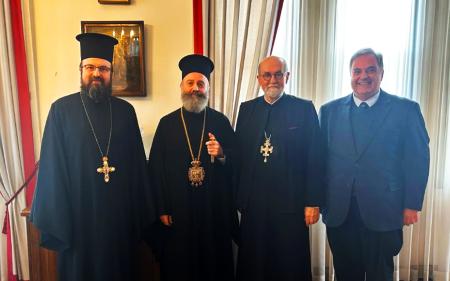
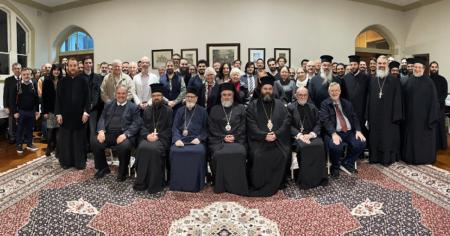
On Sunday, Sept. 17, Fr Chad and Dn Vitaly concelebrated at the Hierarchical Divine Liturgy at the Holy Trinity Cathedral of the Jordanville monastery, presided by His Eminence, Metropolitan Nicholas (Olhovsky) of Eastern America and New York (ROCOR), with 8 other hierarchs and numerous clergy.
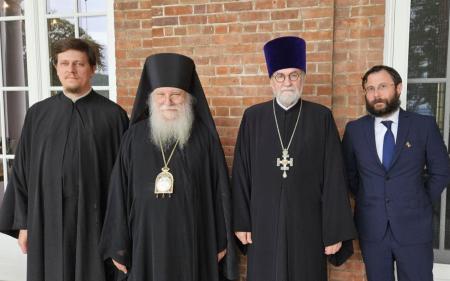
From left: The Rev. Dn Dr Vitaly Permiakov; His Grace Luke, Bishop of Syracuse Vicar of the Eastern American Diocese (ROCOR); The Very Rev. Dr Chad Hatfield; Dr Ionuț-Alexandru Tudorie
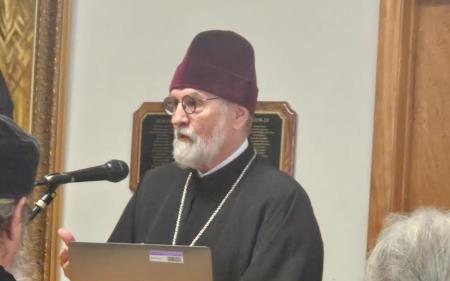
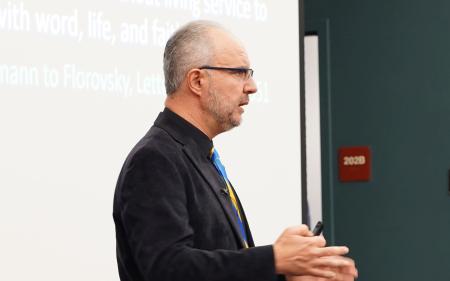
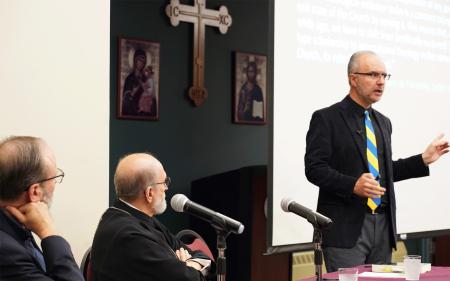
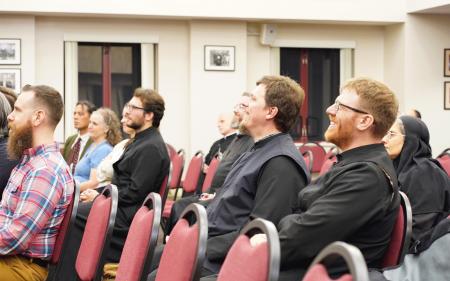
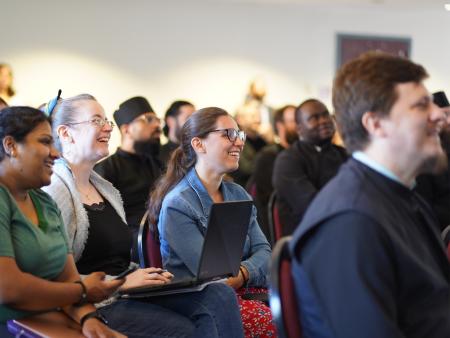
Students, faculty, staff, and community members gathered in person and online on Sep. 12, 2023, to hear scholar and SVS Press author, Dr Paul Gavrilyuk, give a special talk on the contrasting leadership styles of two formational leaders of St Vladimir’s Seminary, Fr Georges Florovsky and Protopresbyter Alexander Schmemann. In his presentation, Dr Gavrilyuk gave many examples from the post-war correspondence between the two past seminary deans to illustrate their sense of calling, their courage in the face of great challenges, and lessons for modern-day Christian leaders.
Dr Gavrilyuk also highlighted the differences in the leadership styles of Fr Schmemann and Fr Florovsky, describing the latter as a brilliant scholar who upheld unyielding academic standards with his students, and the former as a pastoral figure who prioritized the spiritual and personal formation of his students. This divergence in their leadership styles, said Dr Gavrilyuk, inevitably led Fr Schmemann and Fr Florovsky toward their well-publicized rift in 1955, when Fr Florovsky left St Vladimir’s Seminary.
In this presentation, Dr Gavrilyuk took care to provide a compassionate and balanced picture of both Fr Florovsky and Fr Schmemann, asking the audience to consider their historical contexts, as well as the benefits and drawbacks of each of their distinct approaches to leadership. He concluded the presentation on a heartening note, highlighting a letter written by Fr Schmemann in 1968 and reminiscences recorded by a secretary of Fr Florovsky which indicate the two men ended their lives at peace with one another.
Seminary President, the Very Rev. Dr Chad Hatfield, and Professor of Systematic Theology, Dr Peter Bouteneff each gave their own reflections on the two early leaders of St Vladimir’s Seminary. In addition, Fr Chad read a moving reflection from senior staff member, Ted Bazil (M.Div. ‘73), in which Ted described Fr Schmemann’s leadership style as he experienced it, both as a student and as a Seminary employee for the last ten years of Fr Schmemann’s tenure.
Dr Gavrilyuk’s lecture, Christian Leadership in a Time of Crisis: Lessons from Florovsky & Schmemann, was recorded and is available for viewing on the Seminary YouTube channel; click on the link below to access the full presentation.
The St Vladimir’s Seminary community was blessed with a hierarchical visit from His Eminence Archbishop Daniel of Chicago and the Midwest (OCA), for the Feast of the Exaltation of the Cross. His Eminence arrived on Wednesday, September 13, and presided over the Festal Vigil that evening and the Divine Liturgy on the following day.
During the Divine Liturgy, His Eminence gave the homily and ordained third-year seminarian Peter (Jared) Ries (M.Div. ‘24) to the Holy Diaconate. In his homily, Archbishop Daniel emphasized the centrality of the Cross in the Christian life; each Christian must recognize that we belong to Christ; “we belong to Him, and His Cross is engraved on our hearts.” He pointed out the ubiquity of its significance in the sacraments of the Church, including the moment during Ordination to the Holy Diaconate when the person being ordained kisses the cross on the orarion as a sign of his commitment to Christ, our crucified Lord.
Deacon Peter expressed his gratitude and joy at the occasion of his ordination to the Holy Diaconate, saying, “It is a humbling obedience, and it was such a blessing to take on this responsibility while standing alongside my colleagues, mentors, and friends.”
May God grant the newly ordained Dn Peter and Matushka Sophie many blessed years!
Join us for a lecture led by scholar and SVS Press author, Dr Paul Gavrilyuk, on Tuesday, September 12, at 7 p.m. Eastern. In this special talk, Dr Gavrilyuk asks the question, what qualities are required of Christian leaders, especially in a time of crisis? Dr Gavrilyuk's presentation will address this question by focusing on the post-war correspondence between the two past deans of St Vladimir's: Fr Georges Florovsky and Fr Alexander Schmemann. The epistolary exchange between them took place when Schmemann taught at St Sergius in Paris, and Florovsky was a newly appointed dean of St Vladimir's Seminary in New York. Today's Christian leaders can learn much from their example, their sense of calling, and their courage in the face of great challenges.
The presentation is open to the public and free of cost for both in-person and online attendance. It will be held on the St Vladimir’s Seminary campus in the Metropolitan Philip Auditorium, John G. Rangos building, beginning at 7 p.m. Eastern time. The event will also be live-streamed as a Zoom webinar for those who are unable to attend in person.
In keeping with an annual tradition, the primate of the OCA His Beatitude Metropolitan Tikhon visited St Vladimir’s Orthodox Theological Seminary (SVOTS) last week to celebrate the Feast of the Nativity of the Theotokos and to mark the beginning of the academic year with the seminary community.
On Thursday evening, prior to the Festal Vigil, His Beatitude served a Lity for the Departed for the child of God Sophia, daughter of alumnus Fr Silouan Cohen (M.Div. ’22), on the first anniversary of her falling asleep. His Beatitude concelebrated the Festal Vigil with Seminary President, the Very Rev. Dr Chad Hatfield, the Very Rev. Dr Alexander Rentel, OCA Chancellor, and clergy of the seminary community. The antiphonal responses were sung by the seminary mixed and male choirs, under the direction of the Rev. Deacon Dr Harrison Russin, Dr Alexander Lingas, and third-year seminarian, Sam Loposky (M.Div. ‘24).
On Friday, His Beatitude presided at the celebration of the hierarchical Divine Liturgy for the Feast. The responses were sung by the mixed seminary choir led by second-year seminarian Naomi DeHaan (M.A. ‘24). His Beatitude delivered the homily where he encouraged the faithful to act as gardeners and “contribute to the upkeep of paradise… by making ourselves receptive to God, and this receptivity is exemplified by the practice of humility.”
Following the liturgy, His Beatitude addressed the students for the opening of the academic year. In his address, His Beatitude called on students to follow the example of Christ’s Most Pure Mother, filling themselves “with the sacrifice of prayer, songs, and praise offered unto the God of all.”
President of St Vladimir’s Orthodox Theological Seminary (SVOTS), The Very Rev. Dr Chad Hatfield traveled to Sydney, Australia last month to teach in-person intensives for a hybrid summer course on missiology at St Andrew’s Greek Orthodox Theological College (SAGOTC). He was also invited by Archbishop Makarios, primate of the Greek Orthodox Archdiocese of Australia to give a keynote presentation at the College’s 4th Theology Symposium, held on August 18-19, 2023.
The theme of the Symposium was ‘For the Life of the World: the Church’s Missional Identity and Witness Today’. In addressing the participants, Fr Chad described missiology as a discipline worthy of its own niche in theological higher education. Fr Chad spoke on the need to recover the missional identity of the Orthodox Church, drawing on his own experience as a long-term member of the board of the Orthodox Christian Mission Center (OCMC) and as a missionary in South Africa, Guatemala, and Alaska. Presenting his paper entitled ‘Three Foundations for Building Modern Era Missiology,’ he gave three examples of modern missionaries whose lives and practices can serve as models for contemporary Orthodox Christian missionary activity: St Herman of Alaska, the 20th century Anglican missiologist Roland Allen, and Archbishop Anastasios of Albania.
The other keynote speaker at the Symposium was Bishop Dr Themistocles of Nicopolis, Head of the Orthodox Mission Centre in Sierra Leone. Fr Chad spoke highly of his work, noting Bishop Themistocles' own fascinating conversion journey; having been a famous rock musician in his youth, he later went on to attain a Master of Theology at Princeton and a doctorate at Brown University. Since the year 2000, “Brother Themi”, now Bishop Themistocles, has served under the Greek Orthodox Patriarchate of Alexandria and All Africa as a missionary to multiple communities in Kenya and Sierra Leone.
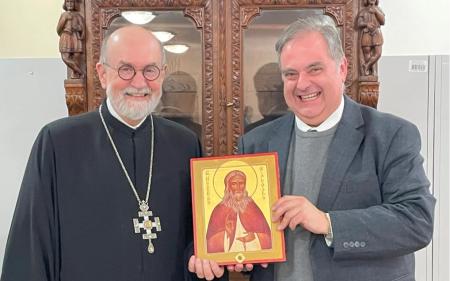
Fr Chad’s presentation at the St Andrew’s College Symposium was the latest in a series of collaborations between SVOTS and the Australian theological school, beginning with visits made by Dean Emeritus, Protopresbyter Dr Thomas Hopko (+2015) in the late 1990’s, and Dean Emeritus, The Very Rev. Dr John Behr in 2016. In a gesture symbolizing the growing partnership between St Vladimir’s Seminary and St Andrew’s College, Fr Chad gifted his Australian hosts with a handpainted icon of St Herman of Alaska, containing a small portion of the saint’s relics.
Dr Philip Kariatlis, Sub-Dean and Associate Professor of Theology at St Andrew’s expressed his gratitude for the gift and for Fr Chad’s presentation as well as the course on missiology he taught this summer, saying, “We are all so grateful for leaving us enriched and edified. The students enjoyed your lectures very much and expressed their joy that our College was able to provide this introductory unit in missiology as part of their program of studies.”
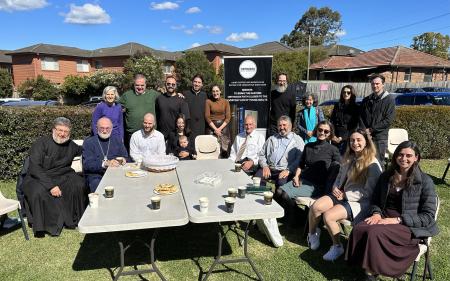
In addition to his work at St Andrew’s College, Fr Chad conducted an adult education class at St Stylianos Orthodox Church in Sydney and gave two interviews for Orthodox podcasts based in Australia, including a podcast hosted at St Cyril’s Coptic Orthodox Theological College. Fr Chad met with several Coptic Orthodox friends including SVS Press author, the Rev. Dr Daniel Fanous.
St Vladimir’s Orthodox Theological Seminary (SVOTS) faculty, staff, and new and returning students marked the beginning of the 2023 Fall Semester on Thursday, August 24, with a Moleben (Prayer Service) for the Beginning of a New Academic Year.
The incoming class of twenty-five men and five women hail from six countries: The United States, Canada, Georgia, Kenya, India, and Romania. The seminarians represent ten Eastern and Oriental Orthodox jurisdictions:
Orthodox Church in America (OCA)
Antiochian Orthodox Christian Archdiocese of North America (AOCANA)
Russian Orthodox Church Outside of Russia (ROCOR)
Moscow Patriarchate in the USA (MP)
Serbian Orthodox Church
Romanian Orthodox Church
Georgian Apostolic Church
Coptic Orthodox Church
Armenian Apostolic Church
Malankara Orthodox Syrian Church
One first-year seminarian, Caleb Rexford, is coming to seminary from the OCA Diocese of the South to enter the Master of Divinity program.
"I am really hoping to grow in every area of my life while here," he said, "I feel like I’m building my house on a good foundation…so that I can speak about my faith in confidence, and someday even be able to teach and guide others."
SVOTS President, The Very Rev. Dr Chad Hatfield addressed the entire student body on Sunday, August 27, exhorting them to approach their seminary education with a balanced, prayerful mindset.
"The formation you receive at St Vladimir’s Seminary should look like a three-legged milking stool," said Fr Chad. "Academic formation, pastoral formation, and spiritual formation–each one of these is an essential aspect of your training here as future clergy and lay leaders who will go out into the world and serve the Church."
Counting the incoming class, the total student body at SVOTS this year is ninety-three seminarians.
Other additions to the faculty for Academic Year 2023-24 include The Rev. John Black (M.Div. ‘23) and The Rev. Nicholas Fine (M.Div. ‘23). Fr John Black will instruct students in the practice of liturgical music in the Russo-Slavic tradition, and Fr Nicholas Fine will give instruction in Byzantine chant.
May the intercessions of the Theotokos and Ever-Virgin Mary, our patron Great and Holy Prince Vladimir, and all the saints be with our seminarians, faculty, and staff as a new academic year commences in service to Christ!
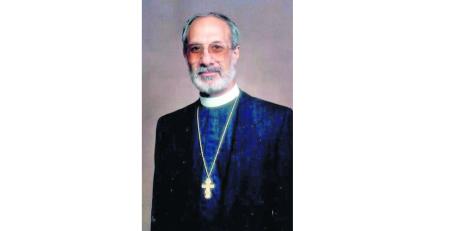
With faith in Christ and hope in the resurrection, we share the news of the repose of Archpriest George S. Corey, who fell asleep in the Lord at age 87. Fr George was born on December 19, 1935, in Charleston, WV. He graduated from Charleston High School in 1954, then attended Holy Cross Greek Orthodox Seminary in Brookline, MA, then St Vladimir’s Orthodox Theological Seminary when it was still located in Manhattan, NY, then the Ecumenical Institute in Bossey which is attached to the University of Geneva, Switzerland. Fr George traveled extensively throughout the Middle East on six different occasions throughout the years. He also attended and graduated from Morris Harvey College (now, The University of Charleston) where he received a Bachelor of Arts degree in Sociology/Psychology. He then received a Master of Divinity degree and Doctor of Ministry from St Vladimir’s Seminary.
As a priest, he served the following parishes during a 35-year period: St Michael Church in Louisville, KY (1962-1966); St George Church (now, Cathedral) in Pittsburgh, PA (1967-1977); St George Church in Boston, MA (1977-1986); St George Cathedral in Coral Gables, FL (1986, his sabbatical parish); and St Nicholas Cathedral in Brooklyn, NY (1987-1997). In 1976, Fr George accompanied Metropolitan Philip (Saliba), the Antiochian Archdiocese Primate of North America to visit the Orthodox Church in the former Soviet Union.
During these 35 years of service, he taught the Orthodox Christian faith at Duquesne University in Pittsburgh, PA; Holy Cross Seminary in Brookline, MA, and at St Vladimir’s Seminary to men studying for the holy priesthood. He also served on the Board of Trustees at St Vladimir’s Seminary as President of the Alumni Association. He served as a Trustee of the Orthodox Monastery of the Antiochian Orthodox Christian Archdiocese of North America, where he also served as Vicar General. He was the longtime editor–for more than 20 years–of The Word, the official publication of the Antiochian Archdiocese.
At the appointment of the Metropolitan Archbishop, Fr George was instrumental in the unification of the New York and Toledo Antiochian Archdioceses, the agreement for which was signed by the bishops in Fr George's Pittsburgh office. He also served in the efforts of the Antiochian Archdiocese with the Orthodox Church in America for the canonization of Bishop RAPHAEL of Brooklyn, NY.
He served as spiritual advisor over a period of years for Teen SOYO and the Fellowship of St John the Divine and helped draft the constitution of the Antiochian Women in North America. For his efforts, he was awarded the Holy Cross of Mount Lebanon by the Archdiocese of Zahle, Lebanon; and he was awarded the Antiochian Gold Medal of Merit from the Archdiocese of North America.
Fr George was medically retired in June 1997 whereupon he moved for a short period of time to Lexington, KY. In January 1998, he moved to Ft Lauderdale, FL, and lived there for twelve years. He worked at a very prestigious bookstore on Las Olas Blvd for two years then was resident manager for a 100-unit apartment building for five years. Fr George then taught at an elementary school for special needs children for two years. He adored those "special" children. He then lived in a retirement home in Ft Lauderdale for two years before deciding to move back to Charleston. People have asked him why he moved home, and he said: "I was born, baptized, and raised in Charleston and I want to die in Charleston." And, so, it has come to pass!
He was preceded in death by his parents, Schakabe "Mutt" and Lena Thabet Corey of blessed memory. Fr George is survived by his son George and wife Ana Lucia and his grandson, Matthew Corey of Westport, CT; his son, David, and wife Megan and his grandsons, Augusten and Jude Corey of Grosse Pointe MI; his son, Michael and his wife Grisel Corey and their twin sons, Marc and Michael of Westport, CT; and, son Jonathon and wife, Brijette and his granddaughter, Livia of Westport, CT.
He is also survived by his sister Dolores Bsharah of Redford, MI; sister Barbara Farha of Jacksonville, FL; and brother Lawrence Corey and his wife Lorraine Corey of Burke, VA - as well as all the stray cats, birds, and squirrels that came daily to his patio to be fed. Neighbors called Fr George "St Francis of Assisi" because of his love for animals.
The funeral services will take place at St George Orthodox Cathedral on the corner of Lee and Court Streets in Charleston, where his earthly remains will lie in repose, as follows: Visitation on Friday, August 25 from 4 - 8 p.m. with a Vespers service at 7, followed by the Trisagion Prayers of Mercy. Saturday, August 26, Divine Liturgy at 10:30 a.m. and Funeral Service at 12 p.m., followed by the interment at Sunset Memorial Cemetery. A meal of mercy will be offered at 3:30 p.m. at the Holiday Inn in South Charleston. Prayers and services are to be conducted by the Dean of the Cathedral, the Rev. Fr Joseph Hazar, Dean Emeritus the Very Rev. Olof Scott, and other visiting clergy.
The graveside service will be held at Sunset Memorial Park in South Charleston. Funeral arrangements have been entrusted to the Freeman Funeral Home of Chapmanville, WV. The Corey family has requested family and friends to refrain from sending flowers. Contributions in Fr George’s memory can be made to St George Orthodox Cathedral, P.O. Box 2044, Charleston, WV 25327-2044 or to Jude Children's Research Hospital, 501 St. Jude Place, Memphis, TN 38105, or to a charity of your choice.